Repair Microwave Oven or Buy New? How to Decide and Hire
To repair microwave oven trouble without wasting money, note the symptom and model number, compare a written quote to the price of a comparable new unit, and hire a registered local technician. Repair when the quote is under half the price of a new microwave and the unit is under about ten years old. Replace it otherwise. Never open the case yourself.
A dead microwave rarely picks a convenient moment. You do not know whether the fix is a small switch or an expensive magnetron, and a search for local help returns a long list of shops that all sound the same. Guess wrong and you either pay for a repair that was never worth it or throw out a unit that needed a minor part. Many homeowners also fear an invoice that grows once the technician is in the kitchen.
This guide walks you through four steps: pin down the fault, decide between repair and replacement, vet a local technician, and book and check the visit. Appliance Worx has repaired household appliances in the Sacramento area for more than 20 years, and the steps below reflect how these jobs actually go. They apply in Sacramento, Fairfield, Vallejo, Vacaville and Stockton, and for brands such as Samsung, LG, GE and Whirlpool.
Why a microwave repair is a job for a pro
A microwave is one of the few appliances where the cover should stay on. The risk is not the microwaves themselves. It is the electrical parts that feed the magnetron, and they stay dangerous after the plug is out.
What makes the inside dangerous
The magnetron, the part that generates the microwaves, runs on a high-voltage circuit built from a transformer, a capacitor and a diode. The capacitor can hold a serious charge long after you unplug the unit. Technicians discharge it first, then test each part with a meter.
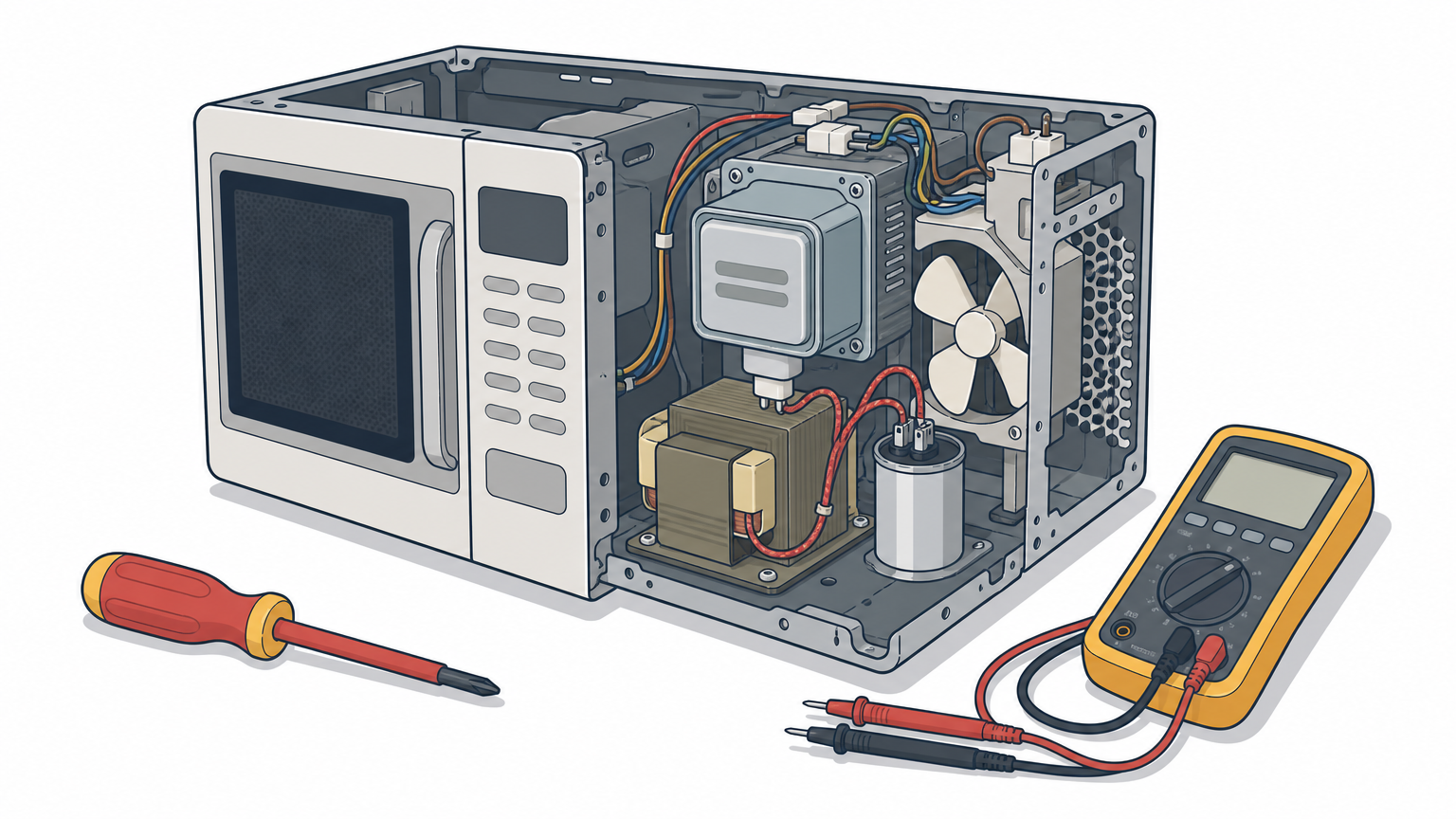
The door interlock switches deserve the same respect. They stop the oven from running with the door open, so a damaged or bypassed switch is a safety problem, not a convenience.
Unplugging a microwave does not make its high-voltage circuit safe to touch.
Which failures are most common
Most service calls trace back to a short list of parts. Knowing the list helps you describe the problem clearly on the phone:
- Door switch or latch: the unit will not start, or stops when you bump the door.
- High-voltage diode, capacitor or magnetron: it runs and the light is on, but food stays cold.
- Turntable roller or motor: the plate does not turn.
- Control board or keypad: buttons are dead, the keypad beeps constantly, or error codes appear.
- Burnt waveguide cover: sparks or arcing inside the cavity.
- Vent fan motor (over-the-range units): steam and smoke do not clear.
Door switches and turntable parts are small repairs. A magnetron or control board costs more, and that cost drives the repair-or-replace decision in Step 2. The only parts you should handle yourself are the glass plate and the roller ring, which lift out by hand.
Step 1. Note the symptom and model number
Write down exactly what the microwave does and find its model number before you call anyone. A technician who has both can often bring the right part and finish in one visit.
Run three safe checks
First, confirm the power . Plug the unit into another outlet, or check the breaker or GFCI that feeds it. Built-in and over-the-range models often sit on a dedicated circuit, so look at the panel.
Next, wipe the door frame and latch, and make sure the door closes fully. Food residue can keep a switch from engaging. Finally, unplug the microwave for a full minute to clear a frozen control board, then test it with a cup of water. Never run it empty , because that can damage the magnetron.
Match the symptom to a likely cause
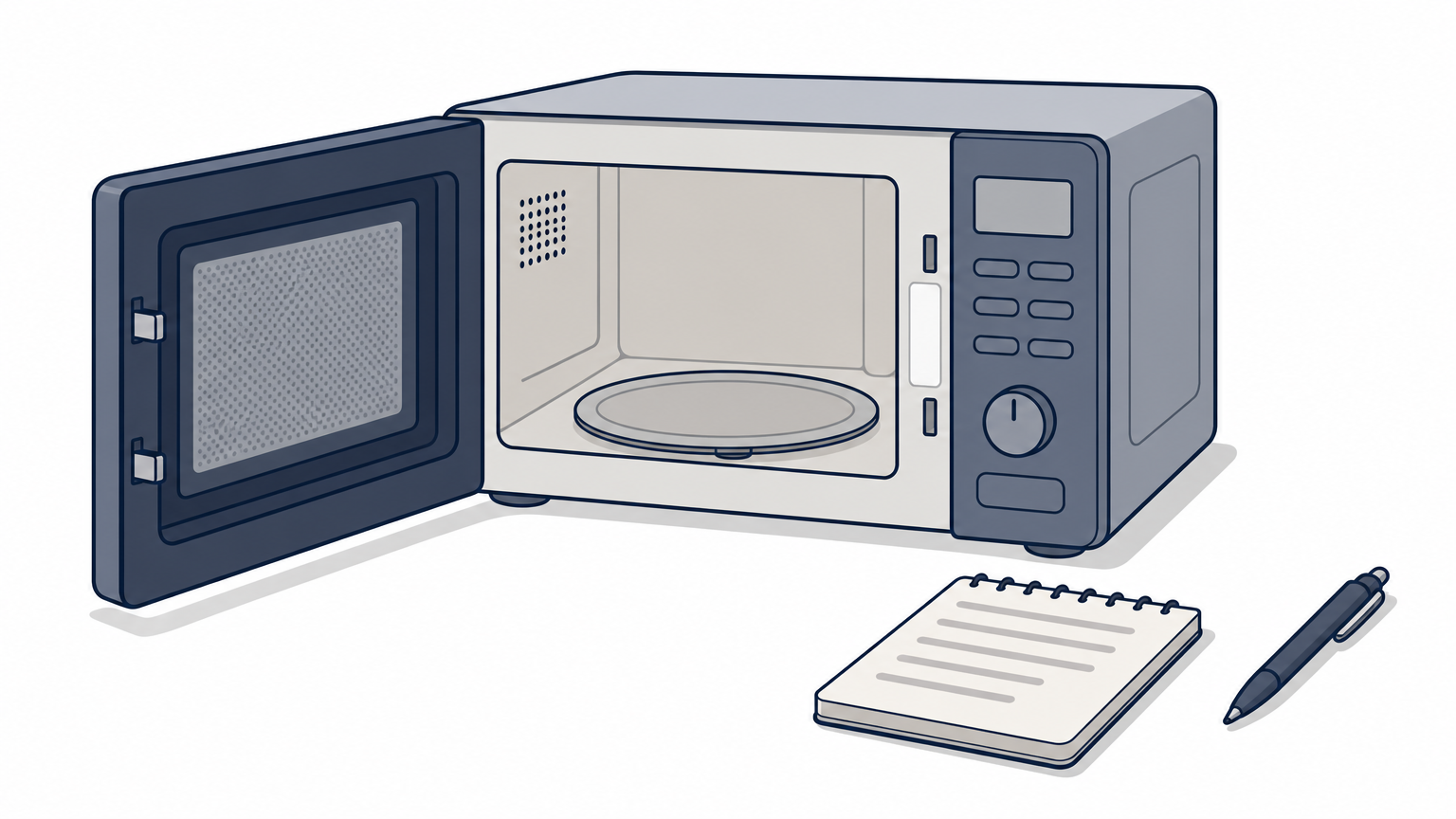
The model number sits on a label, usually inside the door frame, on the back panel or on the side. Appliance Worx has a Find Model # tool that shows where to look on microwaves and other appliances. Then compare what you see with this table.
| Symptom | Likely cause | Typical repair size |
|---|---|---|
| Runs, light on, food stays cold | High-voltage diode, capacitor or magnetron | Mid to large |
| Plate does not turn | Roller ring, coupler or turntable motor | Small |
| Will not start, or stops when the door moves | Door switch or latch | Small |
| Sparks or arcing | Burnt waveguide cover or damaged cavity | Small for the cover, large for the cavity |
| Loud buzzing or humming | Failing magnetron, diode or cooling fan | Mid to large, stop using it |
| Dead or beeping keypad | Membrane switch or control board | Mid |
| Weak vent fan (over-the-range) | Fan motor | Mid |
A clear symptom plus a model number turns a vague phone call into a one-visit repair.
Step 2. Decide whether to repair or replace
Repair the microwave when the written quote is under half the price of an equivalent new unit and the microwave is under about ten years old. Replace it when the quote passes that line or the unit is past its prime.
Apply the half-price rule
New countertop microwaves commonly cost about $100 to $300 . A built-in or over-the-range unit typically runs $500 to $1,500 installed , because the trim kit, finish and cutout must match your kitchen. That gap is why built-ins are the strongest repair candidates and basic countertops rarely are.
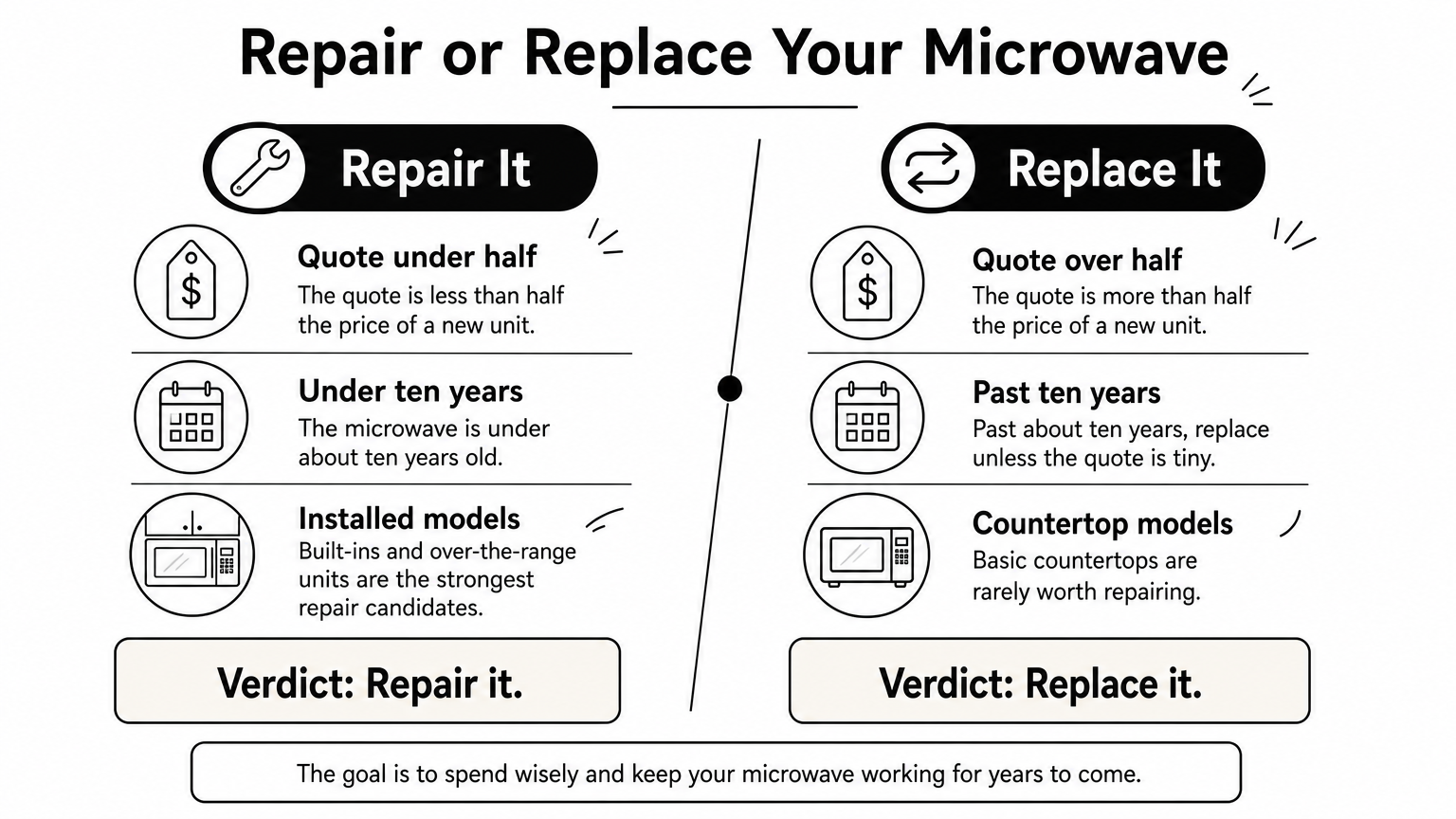
Run your own quote through the same math. These examples use hypothetical figures, with a $1,000 installed replacement taken from the middle of that range:
| Microwave | Age | Quote | New unit | Quote as share of new | Call |
|---|---|---|---|---|---|
| Over-the-range | 7 years | $300 | $1,000 installed | 30% | Repair |
| Over-the-range | 11 years | $300 | $1,000 installed | 30% | Replace, age outweighs price |
| Countertop | 5 years | $150 | $200 | 75% | Replace |
If the quote is more than half the price of a new unit, replace it. If it is less, repair it.
Weigh age, fit and coverage
Microwaves commonly last roughly 7 to 10 years . Near the end of that range, a repair needs a much bigger discount to make sense, and past ten years you should replace the unit unless the quote is tiny.
Check coverage before you pay anything. A manufacturer warranty, an extended plan or a home warranty may cover the repair, and that is the real route to a free repair . Also ask about discounts. Appliance Worx offers senior and military discounts.
A countertop unit that is worth fixing can sometimes go to a shop, since you can carry it in yourself. Built-in and over-the-range models need a house call.
Step 3. Find and vet a local technician
Shortlist two or three companies, confirm each is registered and works on your type of microwave, and compare written estimates before you book. A technician based near you also reaches you faster.
Build a shortlist you can trust
Start with Google Business Profile and Yelp listings. Read the reviews that mention microwaves or your brand, and ask neighbors who they called. Favor reviews that describe honest pricing and clear estimates , because that is the worry behind most of these searches.
Then check the paperwork. California regulates appliance repair through the Bureau of Household Goods and Services, and a legitimate company gives you its registration or license number on request. For reference, Appliance Worx works under California license #47531. Also confirm that the company covers your city, whether that is Sacramento, Fairfield, Vallejo, Vacaville or Stockton, and ask for a realistic arrival window .
Ask these questions before you book
Put these to every company on your list:
- Do you repair my brand and type (countertop, over-the-range or built-in)?
- What does the diagnostic visit cost, and is it credited toward the repair?
- Will the estimate be in writing, with parts, labor and tax listed?
- What warranty covers the parts and the labor?
- Do you carry common parts so the repair can finish in one visit?
- How soon can a technician reach my address?
Warranties vary widely, from 90 days to a year on parts. Appliance Worx gives a written estimate before work begins and backs each repair with one year on parts and ninety days on labor . Use that as a benchmark, and walk away from any company that will not put the estimate in writing.
A price quoted over the phone without a diagnosis is a guess, not an estimate.
Step 4. Book the visit and test the repair
Book a weekday slot, have your notes ready, approve only a written estimate, and test the microwave before the technician leaves.
Prepare for the appointment
Appliance Worx takes calls Monday to Friday, 8:00 am to 5:00 pm, and is closed on weekends. Call early on a weekday for the best chance at a same-day visit, at 916.228.7557 or 707.227.8193, or book online. You can then follow the appointment with the Job Tracker and the Technician Tracker.
Have these ready:
- The model number from the label
- Your notes on the symptom and when it started
- Clear access to the unit, including the range below an over-the-range model
- An adult at home to approve the estimate
Approve, test and keep the paperwork
Read the written estimate before you say yes. It should list parts, labor and tax as separate lines. If you decline, you should owe no more than the diagnostic fee you were quoted when you booked.
After the repair, heat a cup of water for one minute while the technician is still there. Check the turntable, light, keypad and door, and the vent fan on an over-the-range unit. Keep the invoice, because it starts your warranty clock .
Approve the repair in writing and test it before the technician leaves.
What to do next
A good microwave repair follows a clear order. You identify the symptom and model number, run the half-price rule on the quote, hire a registered local technician who writes everything down, and test the result before the visit ends. Leave the high-voltage work to a professional and spend your own effort on the checks and the paperwork.
If your microwave stopped heating, no longer spins or sparks, you can book a microwave repair with Appliance Worx and get a written estimate before any work starts.